IPTV Streaming: How to Pay with Cryptocurrency Safely
Discover how to pay for your IPTV subscription using cryptocurrency. Learn the benefits, top coins, and a simple guide for secure transactions.
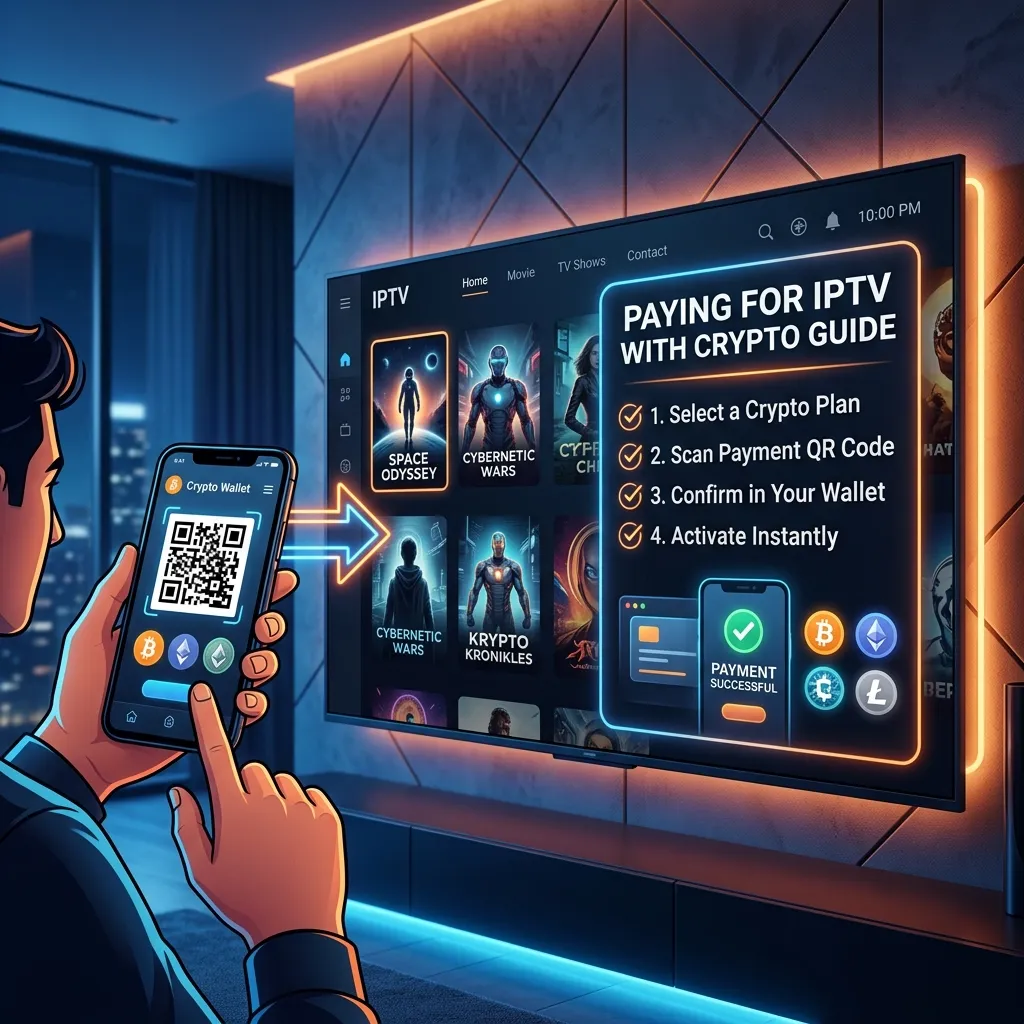
The digital entertainment landscape is undergoing a massive paradigm shift. As millions of viewers worldwide cut the cord and migrate away from overpriced, rigid traditional cable packages, Internet Protocol Television (IPTV) has emerged as the definitive future of broadcasting. But this revolution in what we watch is being matched by an equally significant revolution in how we pay for it. Welcome to the ultimate guide on paying for your IPTV subscription using cryptocurrency.
If you have recently visited our Homepage, you already know that the modern viewer demands freedom, flexibility, and an abundance of high-quality content. However, gaining access to global channels often intersects with the complexities of international banking, privacy concerns, and geo-restrictions. Cryptocurrency perfectly bridges this gap, offering a decentralized, secure, and rapid payment method that aligns perfectly with the ethos of IPTV.
In this exhaustive 3,000+ word guide, we will explore every facet of using digital assets to secure your streaming services. From understanding the core benefits and selecting the right coins, to a granular step-by-step purchasing tutorial, this article is designed to turn even the most novice user into a crypto-savvy streamer.
1. What is IPTV and Why the Cord-Cutting Revolution is Here
Before diving into the financial mechanics of cryptocurrency payments, it is crucial to understand the service you are purchasing.
The Evolution of Television Viewing
Internet Protocol Television, or IPTV, is the delivery of television content over Internet Protocol (IP) networks. Unlike traditional broadcast television—which relies on satellite signals, terrestrial aerials, or physical coaxial cables—IPTV streams media directly through your internet connection. This fundamental difference transforms the television from a passive receiver of scheduled broadcasts into an active, on-demand multimedia hub.
The shift to IPTV represents a democratization of media. Viewers are no longer bound by the localized packages dictated by a handful of massive telecommunications monopolies. Instead, they can access a virtually infinite library of live TV, movies, sports, and international broadcasts.
Why Traditional Cable is Failing
Traditional cable TV is suffering from a terminal illness characterized by bloated contracts, hidden fees, hardware rental costs, and a frustrating lack of flexibility. Consumers are routinely forced to pay exorbitant monthly fees for hundreds of channels they never watch, just to access the few channels they actually care about. Furthermore, when you travel or move, your cable subscription rarely travels with you.
The Ultimate Freedom of IPTV
By securing an IPTV Subscription, viewers regain total control. You can watch your favorite sports teams from halfway across the world, catch up on international news, and binge the latest cinematic releases, all from a single interface. Because the delivery method is entirely digital, IPTV services can be accessed on smart TVs, computers, smartphones, tablets, and dedicated streaming devices. It is the ultimate manifestation of "what you want, when you want, where you want."
2. The Rise of Cryptocurrency in Digital Services
The synergy between IPTV and cryptocurrency is not a coincidence; it is the natural convergence of two technologies designed to bypass outdated, centralized systems.
A Brief History of Crypto as a Medium of Exchange
Since the launch of Bitcoin in 2009, cryptocurrency has evolved from a niche cypherpunk experiment into a multi-trillion-dollar global asset class. While much of the mainstream media focuses on crypto as an investment vehicle or a speculative asset, its original and arguably most powerful use case remains unchanged: serving as a decentralized, peer-to-peer electronic cash system.
Over the last decade, merchants across the globe have slowly integrated crypto payment gateways. Today, you can buy everything from real estate and luxury cars to VPN subscriptions and, of course, streaming services, using digital assets.
Why Digital Services are Adopting Decentralized Finance
Digital services, particularly those operating on a global scale like IPTV providers, face immense challenges when dealing with legacy banking systems. Credit card processors impose high merchant fees, enforce strict regional blocks, and routinely freeze accounts due to arbitrary risk assessments. Cross-border payments can take days to clear and often incur punishing exchange rate fees.
Cryptocurrency eliminates these friction points entirely. A transaction sent from Tokyo to Toronto takes the same amount of time—and costs the same network fee—as a transaction sent across the street. This borderless efficiency makes digital currencies the perfect financial engine for global digital services.
The Synergy Between Cord-Cutters and Crypto Enthusiasts
There is a profound philosophical overlap between people who cut the cord and people who use cryptocurrency. Both groups value autonomy. The cord-cutter rejects the monopolistic control of the cable company; the crypto user rejects the monopolistic control of the central bank. Both seek to eliminate middlemen, reduce unnecessary costs, and take ownership of their respective experiences. It is only natural that these two worlds have collided so seamlessly.
3. Why You Should Pay for IPTV with Crypto
If you have always paid for online services using a credit card or PayPal, you might be wondering why you should change your habits. The transition requires learning a few new steps, but the benefits are overwhelming.
Total Privacy and Anonymity
In an era of relentless data harvesting, privacy is a luxury. When you use a credit card, you surrender a massive amount of personal information: your full legal name, your billing address, your banking institution, and your purchasing habits. This data is logged, tracked, and often sold to third-party data brokers.
When you pay with cryptocurrency, you do not need to provide any of this information. A crypto transaction requires only two things: a sender address and a receiver address. There is no name attached to the transaction, no billing address required, and no credit check. For a deeper understanding of how we protect your data, read our comprehensive Security Guide.
Circumventing Geographic and Banking Restrictions
Many traditional payment processors impose strict geographic limitations. If you live in a region that is unsupported by major payment gateways, or if your local bank arbitrarily blocks transactions to international digital service providers, you may find yourself entirely unable to purchase the subscription you want.
Cryptocurrencies are borderless and permissionless. No bank manager, corporate algorithm, or government regulation can stop you from sending your own money to any wallet address on the planet. If you have an internet connection, you can participate in the global crypto economy.
Eradicating Hidden Fees and Recurring Unauthorized Charges
We have all experienced the nightmare of the "free trial" that quietly transforms into a recurring monthly charge that requires hours on the phone to cancel. Traditional payment methods operate on a "pull" mechanism. When you give a company your credit card details, you are giving them permission to pull funds from your account at their discretion.
Cryptocurrency operates on a "push" mechanism. Funds cannot be pulled from your wallet; they must be actively pushed (sent) by you. This makes unauthorized recurring charges physically impossible. When your IPTV subscription expires, it is entirely up to you to initiate the next payment. You remain in total control of your capital.
Speed and Efficiency
International bank wire transfers can take anywhere from three to five business days to clear. Even credit card payments can be held up in "pending" status for 48 hours. Crypto transactions, depending on the network used, settle in minutes or even seconds. Once the blockchain confirms the transaction, the payment is absolute and final, allowing the provider to activate your service immediately.
4. The Best Cryptocurrencies for Purchasing IPTV Subscriptions
Not all cryptocurrencies are created equal. Some are designed as stores of value, some as privacy shields, and others as rapid mediums of exchange. When navigating to our Pricing page, you will see several options. Here is a detailed breakdown of the best coins to use for your purchase.
Bitcoin (BTC): The Gold Standard
Bitcoin is the oldest, most secure, and most universally recognized cryptocurrency in existence. Virtually every merchant that accepts crypto accepts Bitcoin.
- Pros: Universal acceptance, unmatched network security, highly liquid.
- Cons: During periods of high network congestion, transaction fees can spike significantly. Confirmation times can occasionally take up to 30 minutes.
- Best For: Users who already hold BTC and prioritize maximum security over minor transaction fees.
Ethereum (ETH): The Smart Contract Pioneer
Ethereum is the second-largest cryptocurrency by market capitalization. It powers a massive ecosystem of decentralized applications and smart contracts.
- Pros: Widely accepted, faster block times than Bitcoin.
- Cons: Ethereum is notorious for high "Gas" (transaction) fees. Paying a $15 fee on a $50 subscription makes little financial sense.
- Best For: We generally recommend avoiding mainnet Ethereum for small subscription purchases unless network gas fees are historically low.
Litecoin (LTC): The Silver to Bitcoin's Gold
Created in 2011, Litecoin is a fork of the Bitcoin codebase designed specifically to be lighter, faster, and cheaper. It is frequently referred to as the silver to Bitcoin’s gold.
- Pros: Incredibly low transaction fees (often less than a penny), fast confirmation times (usually under 2.5 minutes), and broad acceptance across payment gateways.
- Cons: Less media hype, meaning some newer users might not hold it.
- Best For: Litecoin is arguably the absolute best "traditional" cryptocurrency for paying for digital goods like IPTV.
Tether (USDT) & USD Coin (USDC): The Stablecoin Solution
Stablecoins are cryptocurrencies pegged directly to the value of a fiat currency, most commonly the US Dollar. One USDT will always equal one USD.
- Pros: Zero price volatility. When you go to checkout, you don't have to worry about the value of your coin crashing while the transaction processes.
- Cons: You must pay close attention to the network you are using to send stablecoins (e.g., sending USDT via the Tron network (TRC-20) is cheap; sending it via the Ethereum network (ERC-20) is expensive).
- Best For: Users who want the efficiency of crypto without the stressful price fluctuations.
Monero (XMR): The Ultimate Privacy Shield
While Bitcoin is pseudonymous (transactions are visible on a public ledger), Monero is entirely anonymous. It uses advanced cryptography to hide the sender, receiver, and transaction amount.
- Pros: Absolute privacy and financial obfuscation. Low fees.
- Cons: Not supported by all payment gateways due to regulatory pressure on exchanges.
- Best For: The privacy purist who wants zero trace of their digital footprint.
Cryptocurrency Comparison Table
To help you make the best decision at checkout, use this quick reference matrix:
| Cryptocurrency | Ticker | Avg. Transaction Time | Avg. Network Fee | Volatility | Best Network to Use |
|---|---|---|---|---|---|
| Bitcoin | BTC | 10 - 30 Minutes | High ($2 - $10+) | High | Bitcoin Mainnet |
| Litecoin | LTC | 2 - 5 Minutes | Very Low (<$0.05) | High | Litecoin Mainnet |
| Tether | USDT | < 1 Minute | Low ($0.50 - $1.00) | None (Pegged) | Tron (TRC-20) / Polygon |
| USD Coin | USDC | < 1 Minute | Low ($0.50 - $1.00) | None (Pegged) | Solana / Polygon |
| Monero | XMR | 2 - 20 Minutes | Low (<$0.10) | High | Monero Mainnet |
| Tron | TRX | < 1 Minute | Very Low (<$0.10) | High | Tron Mainnet |
[!TIP] Pro-Tip for Stablecoin Users: When paying with USDT or USDC, always try to select the TRC-20 (Tron), BEP-20 (Binance Smart Chain), or Polygon networks at checkout. Avoid the ERC-20 (Ethereum) network, as the gas fees will drastically inflate the cost of your subscription.
5. Step-by-Step Guide: How to Pay for IPTV Using Crypto
If you are new to the crypto space, the process might seem intimidating at first. However, once you complete your first transaction, you will realize how streamlined and logical the system actually is. Follow this comprehensive, step-by-step guide to secure your subscription.
Step 1: Selecting and Setting Up Your Crypto Wallet
Before you can spend cryptocurrency, you need a place to store it. You have two primary options:
- Custodial Exchange Wallets: These are wallets provided by major exchanges like Coinbase, Binance, or Kraken. When you buy crypto here, the exchange holds it for you. This is the easiest method for beginners, but you do not own the private keys.
- Self-Custodial Wallets: These are software applications (like Trust Wallet, Exodus, or MetaMask) or hardware devices (like Ledger or Trezor) where you control the private keys. This is vastly more secure and aligns with the ethos of crypto.
Actionable Step: Download a reputable self-custodial software wallet like Trust Wallet or Exodus to your smartphone. Write down your 12-word seed phrase on a physical piece of paper and never share it with anyone.
Step 2: Choosing an Exchange and Buying Your First Crypto
If your wallet is empty, you need to convert some fiat currency (USD, EUR, GBP) into cryptocurrency.
- Sign up for a reputable fiat-to-crypto exchange (e.g., Kraken, Coinbase, or MoonPay).
- Complete the necessary KYC (Know Your Customer) identity verification if required.
- Link your debit card or bank account.
- Purchase your desired cryptocurrency. Based on our earlier breakdown, Litecoin (LTC) or USDT (on TRC-20) are your best bets for cheap, fast transactions.
Step 3: Navigating to the IPTV Provider's Checkout
Once your crypto is ready, head over to our Pricing page.
- Select the subscription duration that fits your needs (e.g., 1 Month, 6 Months, 12 Months).
- Proceed to the checkout page.
- Fill in the required details (usually just an email address where your credentials will be sent).
- Under the "Payment Method" section, select "Cryptocurrency".
Step 4: Understanding the Payment Gateway
When you select crypto checkout, you will be redirected to a secure payment gateway (such as CoinPayments, BTCPay Server, or a direct merchant portal). The screen will display three critical pieces of information:
- The specific amount of crypto required (e.g., 0.543 LTC).
- The destination wallet address (a long string of random letters and numbers).
- A QR Code representing the destination address.
- A countdown timer (usually 15 to 30 minutes) to lock in the exchange rate.
Step 5: Network Selection – The Critical Step
[!CAUTION] Network Mismatch Warning: If you are paying with a token like USDT, you must ensure that the network you select in your wallet matches the network displayed on the checkout page. If the checkout asks for USDT via the TRC-20 network, and you send USDT via the ERC-20 network, your funds will be permanently lost in the blockchain void. The merchant will never receive them, and they cannot be recovered. Always double-check the network!
Step 6: Sending the Funds and Awaiting Confirmations
- Open your crypto wallet.
- Select "Send" or "Withdraw".
- Choose the cryptocurrency you are paying with.
- Copy the destination address from the checkout page and paste it into your wallet, or simply use your phone's camera to scan the QR code on your computer screen.
- Important: Enter the exact amount of cryptocurrency requested on the checkout page. Do not send more, and absolutely do not send less. If you underpay by even a fraction of a cent, the automated system will not recognize the invoice as paid.
- Review the transaction details (Amount, Address, Network Fee) and click "Confirm/Send".
Once sent, leave the checkout page open. Within a few minutes, the blockchain will process your transaction. The checkout page will automatically detect the incoming payment, update to "Confirming," and finally display a "Payment Successful" message.
6. Setting Up Your IPTV After a Crypto Purchase
Congratulations! You have successfully bypassed the traditional financial system and secured your premium entertainment package. The next step is getting that content onto your screen.
Check Your Inbox: Receiving Your Credentials
Unlike physical goods, IPTV delivery is instant. As soon as the blockchain confirms your transaction (usually 1-3 network confirmations, taking roughly 5 to 15 minutes depending on the coin), our automated servers spring into action.
Check the email address you provided during checkout. You will receive a welcome email containing your vital connection details. This usually includes:
- Your Username and Password.
- The Portal URL (Server URL).
- An M3U Playlist Link.
- An EPG (Electronic Program Guide) Link.
Note: Always check your Spam or Junk folders if the email does not appear in your primary inbox within 20 minutes of the crypto transaction confirming.
Universal Setup Instructions for Smart TVs and Devices
IPTV is highly versatile. Whether you are using an Android TV, an Apple TV, an LG webOS screen, or a Windows PC, there is an application for you. Popular apps include TiviMate, IPTV Smarters Pro, and XCIPTV.
For a comprehensive walkthrough on how to input your new credentials into these applications, please refer to our ultimate Installation Guide. It provides step-by-step screenshots for almost every major device on the market.
Optimizing Your Firestick for the Ultimate Experience
The Amazon Fire TV Stick remains the single most popular device for IPTV consumption due to its low cost, portability, and Android-based architecture, which allows for easy sideloading of third-party applications.
If you purchased your subscription specifically to use on an Amazon device, you will need to enable "Apps from Unknown Sources" before you can download the best IPTV players. We have created a dedicated, deeply detailed tutorial specifically for this platform. Head over to our Firestick Setup guide to unlock the full potential of your device in under ten minutes.
7. Potential Pitfalls and How to Avoid Them
While paying with crypto is generally a smooth process, the decentralized nature of the technology means there is no central customer service hotline if you make a mistake. You are your own bank. Here are the most common pitfalls users encounter and exactly how to avoid them.
The Danger of Sending to the Wrong Network
As highlighted earlier, this is the number one cause of lost funds. Cryptocurrencies often exist on multiple different blockchains. Binance Coin (BNB), for example, exists on both the BEP-2 (Binance Chain) and BEP-20 (Binance Smart Chain) networks. Tether (USDT) exists on Ethereum, Tron, Solana, Polygon, and Avalanche.
The Fix: Read the checkout instructions carefully. The payment gateway will explicitly state which network it expects. When withdrawing from your wallet or exchange, ensure the selected network matches exactly.
Accounting for Transaction Fees (Don't Underpay!)
When you send crypto from an exchange to a merchant, the exchange will charge a withdrawal fee.
Example: Your IPTV subscription costs exactly 50 USDT. The exchange charges a 1 USDT withdrawal fee. If you tell the exchange to send 50 USDT, it will deduct its fee from that amount, and the merchant will only receive 49 USDT. The automated payment gateway will register this as an "underpayment" and your service will not be activated.
The Fix: Always factor in the fee. In the example above, you must instruct the exchange to send 51 USDT, ensuring exactly 50 USDT arrives at the destination address. Most modern wallets (like Trust Wallet) calculate the network fee on top of your send amount automatically, but central exchanges often deduct it from the total. Pay close attention to the "Recipient Will Get" figure before confirming.
Dealing with Exchange Withdrawal Delays
Sometimes, centralized exchanges (like Coinbase or Binance) will put a temporary hold on your withdrawal for security checks, or they may batch transactions during periods of high network traffic. If the payment gateway's 30-minute timer expires before the exchange actually broadcasts the transaction to the blockchain, the invoice will time out.
The Fix: We highly recommend sending funds from a self-custodial wallet (like Exodus or Trust Wallet) rather than directly from an exchange. When you send from a self-custodial wallet, the transaction is broadcast to the network instantly, guaranteeing you beat the checkout timer.
Phishing Scams and Fake Payment Portals
The internet is rife with bad actors attempting to steal cryptocurrency. A common scam involves creating fake websites that look identical to legitimate IPTV providers. When you go to check out, you are actually sending crypto directly into a scammer's wallet.
The Fix: Only ever purchase subscriptions through our official domain. Bookmark our site. Never click on random links sent via unsolicited emails or Telegram DMs claiming to offer "discounted renewals." Check the URL bar to ensure you are on the authentic Smartiflix platform.
8. Security and Legal Considerations
When mixing streaming services and cryptocurrency, it is natural for users to have questions regarding the legality and security of the process.
Is Buying IPTV with Crypto Legal?
Yes. Purchasing services using cryptocurrency is entirely legal in most jurisdictions around the world. Cryptocurrency is recognized as a legitimate medium of exchange or digital property in the US, Canada, the UK, and throughout the European Union. Buying an IPTV subscription with Bitcoin is legally indistinguishable from buying a cup of coffee with Bitcoin.
Do You Still Need a VPN if You Pay with Crypto?
This is a very common question. It is important to distinguish between payment privacy and network privacy.
- Paying with crypto protects your financial privacy. It prevents banks and data brokers from knowing what you bought.
- A Virtual Private Network (VPN) protects your network privacy. It encrypts your internet traffic so your Internet Service Provider (ISP) cannot see that you are streaming video data.
While crypto secures the purchase, your ISP can still monitor your internet traffic and throttle (slow down) your connection if they detect heavy streaming activity. Therefore, using a high-quality VPN in conjunction with your IPTV service is highly recommended to ensure a buffer-free, totally private viewing experience.
Protecting Your Wallet from Hacks
Your crypto is only as secure as the wallet holding it. Never store large amounts of cryptocurrency on an exchange. Never take a screenshot of your seed phrase or save it in a cloud text document (like Google Drive or iCloud). Write it down on physical paper and store it in a fireproof safe. If you plan to hold significant amounts of crypto long-term, invest in a hardware wallet like a Ledger or Trezor.
9. Frequently Asked Questions (FAQs)
To round out this guide, let's address some of the most common questions our support team receives regarding cryptocurrency payments.
Q: Do I get a refund if I am unhappy with the service after paying with crypto? A: Due to the irreversible nature of blockchain transactions, offering automated refunds for crypto payments is technically complex. However, we stand behind our service. If you experience technical issues that our support team cannot resolve, we handle refunds on a case-by-case basis. In these instances, you will need to provide a receiving wallet address, and the refund will be processed manually (minus the network gas fees).
Q: Can I set up an auto-renewal using cryptocurrency? A: No. As explained earlier, crypto is a "push" system, not a "pull" system. Smart contracts can facilitate recurring payments in some advanced DeFi ecosystems, but for standard IPTV subscriptions, you will need to manually process a new payment when your term expires. We will send you an email reminder a few days before your expiration date so you never miss a match.
Q: What happens if the crypto price crashes during my checkout process? A: Payment gateways lock in the exchange rate the moment the invoice is generated, usually for a period of 15 to 30 minutes. As long as you send the exact required crypto amount within that time window, your payment will be accepted, regardless of what the broader market does in the background.
Q: I sent the crypto, but my invoice says "Underpaid." What do I do? A: This happens when you fail to account for the withdrawal fee. The payment gateway will usually display exactly how much is still owed. You have two options: either send the remaining fractional amount (though the network fee for a second transaction might make this costly), or contact our support team with your transaction hash (TxID). In many cases, if the underpayment is extremely small, our team can manually force-approve the invoice for you.
Q: Which network is the absolute cheapest for paying? A: Currently, using Litecoin (LTC) on the Litecoin network, or Tron (TRX) on the Tron network, results in the lowest possible fees—often a fraction of a single cent.
10. Conclusion
The transition from traditional cable to IPTV represents a leap toward viewing freedom; the transition from fiat currency to cryptocurrency represents a leap toward financial freedom. By combining the two, you secure unparalleled access to global entertainment while maintaining absolute privacy, bypassing outdated banking restrictions, and eliminating the risk of hidden fees.
While the initial setup of a crypto wallet might seem like a daunting task for a beginner, it is a skill that will serve you well far beyond purchasing television services. We are moving rapidly toward a decentralized digital economy, and taking the time to understand these mechanics puts you ahead of the curve.
Ready to cut the cord and take control of your entertainment? Head over to our Pricing page, select your package, and experience the seamless efficiency of paying with crypto today. Welcome to the future of television.