IPTV Streaming Guide for Champions League Fans: Watch Live
Unlock the secrets to IPTV streaming of the UEFA Champions League. Get tips on setup, devices, and apps to never miss a match!
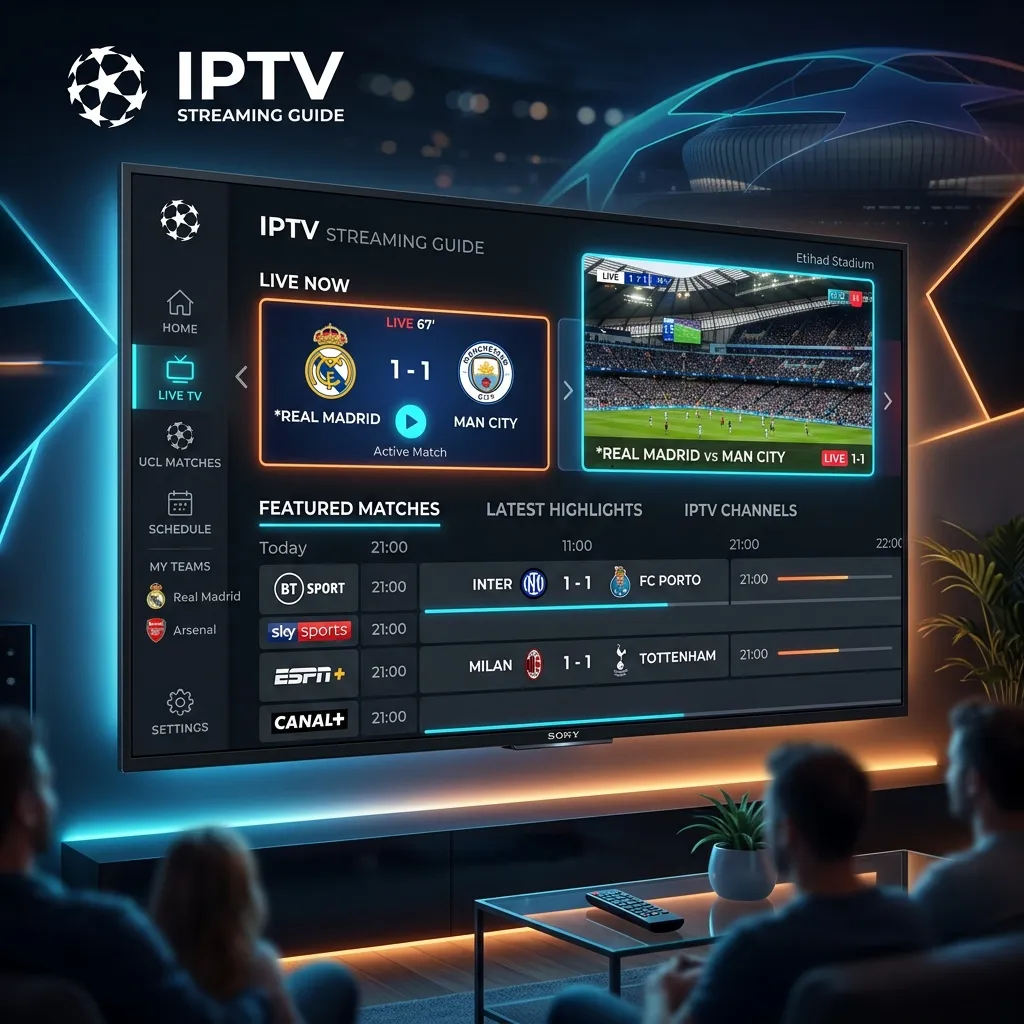
Introduction: The Unrivaled Magic of the UEFA Champions League
There is simply nothing in the world of club football that compares to the sheer spectacle, drama, and intensity of the UEFA Champions League. It is not merely a football tournament; it is a global cultural phenomenon that stops the world in its tracks. Every Tuesday and Wednesday night from September through May, millions of football fans around the globe tune in to witness the absolute pinnacle of the beautiful game. When that iconic, spine-tingling Champions League anthem begins playing and the camera pans across the faces of the world's greatest players lining up under the blinding floodlights, it creates a magical experience that transcends language, borders, and fierce historical rivalries.
Whether you are reminiscing about Liverpool's impossible, gravity-defying comeback against AC Milan in Istanbul in 2005, Manchester United's breathtaking injury-time triumph over Bayern Munich at the Camp Nou in 1999, or Real Madrid's unparalleled, seemingly inevitable dominance of the competition over the past decade, the Champions League consistently delivers unmatched sporting drama. It is the stage where legends are born, where the Ballon d'Or is often decided, and where the most tactically astute managers pit their wits against one another in high-stakes, two-legged chess matches.
However, despite the immense global popularity of this prestigious tournament, watching it live has arguably never been more complicated, restrictive, or expensive for the average supporter. Traditional broadcasting rights have been fractured, sliced into regional packages, and sold off to the highest bidder in almost every country on Earth. A passionate fan who simply wants to follow their favorite team through their domestic league campaigns, domestic cup runs, and European adventures often finds themselves forced into a corner, mandated to subscribe to three or four different premium cable or streaming packages just to catch all the action. The financial costs are astronomical, the long-term contracts are suffocating, and the actual viewing experience is frequently marred by outdated set-top box technology, frustrating geographical blackouts, and notoriously unhelpful customer service. This highly frustrating and fragmented landscape has driven a massive technological shift in how modern audiences choose to consume live sports. Enter the revolution: IPTV. By leveraging internet protocol television, fans are taking back control, and in this exhaustive guide, we will explore exactly how you can elevate your Champions League viewing experience to unprecedented heights.
The Evolution of Sports Broadcasting: From Monopolized Cable to the Freedom of IPTV
To truly appreciate the liberating power of IPTV, one must first understand the restrictive history of sports broadcasting. For decades, watching elite football meant being inextricably tied to a rigid, highly expensive cable or satellite television contract. In the United Kingdom, for instance, Sky Sports held an iron grip on top-tier football broadcasting for years before BT Sport (now rebranded as TNT Sports) entered the fray, securing the exclusive rights to the UEFA Champions League in a multi-billion pound deal. While this injected competition into the market, it did not lower prices for the consumer; rather, it forced fans to purchase both Sky and BT packages if they wanted a complete footballing diet.
A similar story has unfolded in the United States. Fans there have watched the Champions League bounce from Fox Sports to Turner Sports, and eventually to CBS Sports. While CBS has been widely praised for its exceptional coverage—featuring the wildly popular studio crew of Kate Abdo, Thierry Henry, Micah Richards, and Jamie Carragher—the rights are hidden behind the Paramount+ paywall. In other regions, platforms like DAZN, BeIN Sports, and SuperSport hold the keys to the kingdom.
This hyper-fragmentation means that a global citizen or an expatriate living abroad is completely locked out of their preferred native coverage due to strict geo-blocking. If a British fan travels to Spain on holiday, they cannot simply log into their TNT Sports app to watch the game; they are blocked by international broadcasting laws. Furthermore, traditional cable companies bundle these highly desirable sports channels with hundreds of channels you will never watch, forcing you to subsidize reality TV, outdated movies, and obscure cooking shows just to watch 90 minutes of football.
The introduction of IPTV has completely shattered this archaic, anti-consumer model. By bypassing the need for physical satellite dishes, miles of coaxial cables, and proprietary set-top boxes, IPTV delivers high-definition content directly over your existing internet connection. This paradigm shift democratizes sports viewing. It strips away the unnecessary bloat, eradicates geographical borders, and places the power firmly back into the hands of the viewer. The shift from cable to IPTV is not just a change in technology; it is a fundamental change in the economics of being a football fan. For those ready to make the switch, finding a reliable IPTV Subscription is the crucial first step toward broadcasting freedom.
What Exactly is IPTV and How Does It Deliver Live Football?
IPTV stands for Internet Protocol Television. At its core, it is a method of delivering television content over Transmission Control Protocol/Internet Protocol (TCP/IP) networks, as opposed to traditional terrestrial, satellite, and cable television formats. While standard television broadcasts send signals through the air to an antenna or via a physical cable network to a localized region simultaneously (a process known as multicasting), IPTV sends specific media streams directly to individual viewers upon request (unicasting).
When you select a live Champions League match on an IPTV platform, your device sends a request to the provider’s server. The server then breaks down the live video feed into tiny data packets and transmits them over the internet to your device, where they are reassembled and displayed as a continuous, seamless video stream.
This process has evolved dramatically over the last five years. In the early days of internet streaming, watching live sports was a miserable experience plagued by constant buffering, pixelation, and a massive delay compared to live action. If your neighbor was watching via satellite, you would hear them cheering a goal thirty seconds before you actually saw the ball hit the back of the net on your stream.
Today, thanks to the exponential growth of high-speed broadband internet, fiber-optic networks, and sophisticated Content Delivery Networks (CDNs), premium IPTV services can deliver live football in stunning 4K resolution at a buttery-smooth 60 frames per second. CDNs work by placing servers in multiple geographic locations around the world. When you request a stream, the system automatically connects you to the server closest to your physical location, drastically reducing latency and ensuring a rock-solid, uninterrupted feed. This technological leap makes IPTV not just a viable alternative to satellite TV, but a vastly superior one.
The Staggering Economics of Football Fandom: Traditional Subscriptions vs. IPTV
Let us perform a realistic financial breakdown to illustrate why millions of fans are cutting the cord. Consider a passionate football fan living in a major market like the UK or the US.
To legally access every match of their favorite team across all competitions, they must navigate a minefield of subscriptions:
- Domestic League Package 1 (e.g., Sky Sports / NBC Sports): Approximately $40 - $50 per month.
- Domestic League Package 2 (e.g., TNT Sports / Peacock): Approximately $15 - $30 per month.
- Domestic Cup Competitions (e.g., ESPN+ / BBC/ITV License Fee): Variable, often around $10 - $20 per month.
- European Competitions (Champions League, Europa League): Dedicated subscription, around $10 - $30 per month.
When you tally these up, an avid fan is easily spending between $75 and $130 per month just on sports subscriptions. Annually, this equates to a staggering $900 to $1,500. And this does not even account for Pay-Per-View (PPV) boxing or MMA events, which can cost an additional $70+ per event.
Contrast this exorbitant, piecemeal approach with a modern IPTV solution. A premium IPTV service consolidates every single one of these sports channels—from every country, in multiple languages—into one unified, easy-to-navigate platform. Instead of paying upwards of $100 a month, fans can secure an all-encompassing service for a fraction of the cost. When you look at our Pricing structure, the financial logic of switching to IPTV becomes undeniable. You are not only saving hundreds, if not thousands, of dollars a year, but you are also gaining access to a vastly larger catalog of international sports, movies, and on-demand TV series. It is the ultimate cord-cutting financial victory.
| Feature / Service | Traditional Cable/Satellite Packages | Premium IPTV Services |
|---|---|---|
| Average Monthly Cost | $80 - $150+ (Multi-pack required) | $10 - $20 (Flat rate) |
| Contract Length | Usually 12-24 months lock-in | Monthly, Quarterly, or Yearly (No lock-in) |
| Hardware Required | Expensive proprietary set-top box | Firestick, Smart TV, Phone, PC |
| Global Channel Access | Strictly limited to your region | Thousands of global channels |
| PPV Events | Extra cost ($50-$80 per event) | Included at no extra cost |
| Installation | Requires technician visit and dish setup | Instant digital delivery & self-setup |
Choosing the Best IPTV Service for Live Sports: Key Features to Demand
Not all IPTV providers are created equal, and when the Champions League final is on the line, you cannot afford to rely on a subpar service. When selecting an IPTV provider specifically for live sports, there are several critical technical and operational features you must demand.
1. Robust Anti-Freeze Technology
Live football is fast-paced. A single second of buffering can mean missing the decisive goal of the season. Premium providers invest heavily in H.264 and H.265 (HEVC) compression algorithms and dedicated sports servers equipped with anti-freeze technology. This ensures that even during peak traffic times—such as a heavily anticipated El Clásico or a Champions League final—the stream remains stable, fluid, and artifact-free.
2. High Frame Rate (60 FPS) and 4K Resolution
Watching a slow-paced drama in 30 frames per second (FPS) is fine, but sports demand higher frame rates. At 30 FPS, a fast-moving football can look blurry, leaving a ghosting trail across the screen. A top-tier provider offers dedicated sports channels broadcasting in 50 FPS or 60 FPS, providing a crystal-clear, lifelike viewing experience. Furthermore, access to true 4K UHD channels ensures that every blade of grass on the pitch is vividly detailed.
3. Comprehensive Electronic Program Guide (EPG)
Navigating thousands of channels is impossible without a good map. A reliable EPG acts as your TV guide, showing you exactly what is playing and when. For Champions League nights, a perfectly synced EPG allows you to see when the pre-match build-up starts, ensuring you do not miss a minute of the expert analysis.
4. Catch-Up TV and Video On Demand (VOD)
Due to time zone differences, a live match in Europe might air while you are at work or asleep. Catch-Up TV is a revolutionary feature that automatically records and stores live channels for 48 to 72 hours, allowing you to replay the match at your convenience without knowing the final score. Additionally, a rich VOD library provides access to classic matches, sports documentaries, and season highlights.
5. Multi-Device Compatibility
You should have the freedom to watch the match on your 65-inch OLED TV in the living room, your iPad on the train commute, or your smartphone while waiting at a restaurant. Your chosen provider must support multiple device formats and offer seamless integration with the best M3U and Xtream Codes applications.
The Ultimate Devices for Streaming Live Football via IPTV
The hardware you use to process and display your IPTV stream is just as important as the service itself. Processing a high-bitrate 4K sports stream requires decent computing power and a reliable network interface. Here is a comprehensive breakdown of the best devices for the job.
1. The Amazon Fire TV Stick 4K Max (The Undisputed King)
The Amazon Firestick is universally regarded as the best device for IPTV, striking the perfect balance between affordability, processing power, and user freedom. Unlike heavily restricted ecosystems, the Fire OS (which is based on Android) allows users to easily "sideload" third-party IPTV applications that are not officially available on the Amazon App Store. The 4K Max version features an upgraded processor, more RAM, and Wi-Fi 6 support, making it an absolute powerhouse for handling uncompressed sports streams. If you are ready to set up your device, our detailed Firestick Setup guide will walk you through the entire process in under 10 minutes.
2. Premium Android TV Boxes (Nvidia Shield TV Pro)
If budget is not an issue and you demand the absolute pinnacle of streaming hardware, the Nvidia Shield TV Pro is the holy grail. Equipped with the Tegra X1+ processor and highly advanced AI upscaling technology, it can take a standard 1080p HD stream and upscale it to near-4K quality in real-time. It boasts gigabit Ethernet ports, expandable storage, and unparalleled processing speed, ensuring that navigating massive IPTV playlists containing 50,000+ channels is lightning fast and completely lag-free.
3. Apple TV 4K
For those deeply entrenched in the Apple ecosystem, the Apple TV 4K offers a brilliantly smooth, ad-free, and highly polished interface. The A15 Bionic chip inside the latest models handles sports streams effortlessly. While Apple's walled garden prevents the easy sideloading of apps, there are several outstanding IPTV players officially available on the App Store, such as IPTVX, UHF, and Snappier, which offer gorgeous, Apple-esque user interfaces.
4. Smart TVs (LG WebOS and Samsung Tizen)
Modern Smart TVs from LG and Samsung come with their own proprietary operating systems. While these TVs are convenient because they eliminate the need for an external dongle, their processing power is often inferior to a dedicated Firestick or Nvidia Shield. Nevertheless, apps like IBO Player, Flix IPTV, and Smart IPTV are available directly from their respective app stores, offering a straightforward, albeit slightly slower, IPTV experience.
5. MAG Boxes (The Traditionalist's Choice)
Produced by Infomir, MAG boxes (like the MAG 524) are hardware devices built specifically and exclusively for IPTV. They do not run Android; they run a closed Linux-based OS that connects directly to IPTV portal servers via MAC address. They are renowned for their incredible speed in changing channels (zapping speed) and offer an experience virtually identical to an old-school cable box.
The Best IPTV Applications for a Seamless Sports Experience
Hardware alone cannot deliver the match; you need a powerful software application to act as the player. These applications do not provide the content themselves; rather, they act as the media player that reads the M3U playlist or Xtream Codes provided by your IPTV service and presents it in an intuitive, cable-like interface.
TiviMate IPTV Player (Android/Fire OS)
TiviMate is widely considered the gold standard of IPTV players. Designed specifically for TV screens (not touchscreens), its interface is breathtakingly modern, highly customizable, and incredibly fast. It features a traditional TV guide layout, picture-in-picture mode, multi-view (allowing you to watch up to four Champions League matches simultaneously on the same screen), and excellent catch-up integration. The premium version of TiviMate is an essential purchase for any serious sports fan.
IPTV Smarters Pro (Multi-Platform)
IPTV Smarters Pro is arguably the most popular and widely used app in the world, primarily due to its massive cross-platform availability. It works on Android, iOS, Windows, macOS, and Smart TVs. It uses a very straightforward dashboard design categorized into Live TV, Movies, Series, and Catch-up. While its UI is slightly more dated than TiviMate's, its reliability, simplicity, and ease of setup make it a fantastic choice for beginners.
XCIPTV Player
XCIPTV is another fantastic option, heavily favored by IPTV providers who white-label the app. It boasts a very dark, sleek aesthetic and comes with a built-in ExoPlayer and VLC Player. Its VOD section is particularly well-designed, pulling in rich metadata from IMDB to display movie posters, cast information, and ratings beautifully.
Formuler’s MYTVOnline 3
If you purchase a Formuler Android box, you get access to their proprietary app, MYTVOnline 3. This app is universally praised for bridging the gap between traditional cable boxes and IPTV. It offers universal search, a stunning UI, and a dedicated remote control experience that makes it feel exactly like a high-end satellite receiver.
Step-by-Step Configuration: Getting Ready for Match Day
Setting up IPTV for the first time might seem daunting to a beginner, but it is actually a straightforward process. Here is a general overview of how to get everything running smoothly before kick-off. For highly specific, device-by-device instructions, please consult our comprehensive Installation Guide.
- Obtain Your Credentials: Once you subscribe to a service, you will receive an email containing your login credentials. This typically comes in two formats: an M3U URL (a very long web link) or Xtream Codes API login details (a server URL, a username, and a password). Xtream Codes is generally preferred as it loads faster and updates the EPG more efficiently.
- Download the App: Install your chosen app (e.g., TiviMate or Downloader on Firestick to sideload Smarters).
- Input the Details: Open the app, select "Add Playlist" or "Login with Xtream Codes API," and carefully type in the details provided in your welcome email. Note that these are case-sensitive.
- Allow the Playlist to Download: Upon hitting enter, the app will connect to the server and begin downloading the channel list, movie library, and EPG data. This can take a few minutes depending on the size of the playlist.
- Organize Your Favorites: Champions League nights are chaotic. You do not want to be scrolling through 10,000 channels at 7:59 PM looking for the match. Create a "Favorites" group and add your preferred sports channels (e.g., TNT Sports Ultimate, CBS Sports Network, DAZN 1) to this list well in advance.
Defeating Buffering: How to Optimize Your Home Network
There is nothing more rage-inducing than seeing the dreaded buffering circle appear just as a striker is bearing down on the goalkeeper. While provider server issues can occasionally occur, the vast majority of buffering issues are entirely local and related to the user's home network. Here is how to bulletproof your setup for 4K streaming.
The Ethernet Imperative
Wi-Fi is incredibly convenient, but it is highly susceptible to interference. Walls, microwave ovens, Bluetooth devices, and even your neighbors' overlapping Wi-Fi networks can cause packet loss and micro-stutters. For live, high-bitrate streaming, a hardwired Ethernet connection is non-negotiable. If your router is far from your TV, consider investing in a high-quality Powerline Adapter. These ingenious devices use your home's existing electrical wiring to transmit network data, effectively giving you an Ethernet connection in any room without running long cables.
Understanding Internet Speed Requirements
A common misconception is that you need gigabit internet to stream IPTV. This is false. A stable, consistent connection is far more important than raw peak speed.
- Standard Definition (SD): 5-10 Mbps
- High Definition (1080p HD): 15-25 Mbps
- Ultra High Definition (4K UHD): 35-50 Mbps
Ensure that other heavy bandwidth activities (like downloading large video games or uploading massive files) are paused during the match to guarantee your streaming device gets the bandwidth it requires.
Router Optimization and DNS Configuration
Internet Service Providers (ISPs) often use notoriously slow and inefficient DNS (Domain Name System) servers. By accessing your router settings or your device's network settings and changing the primary DNS to Cloudflare (1.1.1.1) or Google (8.8.8.8), you can significantly speed up the time it takes for your device to resolve server addresses, resulting in snappier channel zapping. Furthermore, if your router supports QoS (Quality of Service), prioritize the MAC address of your streaming device to ensure it always receives priority bandwidth traffic.
The Critical Importance of Security and Privacy on Champions League Nights
When it comes to streaming live sports via IPTV, privacy and security cannot be treated as an afterthought. Throughout Europe and North America, ISPs have actively begun implementing aggressive traffic shaping and throttling protocols specifically designed to target live sports streams.
[!WARNING] During high-profile Champions League matches, major telecom companies use Deep Packet Inspection (DPI) to monitor your internet traffic. If they detect a continuous high-bandwidth stream, they will throttle it, causing your match to buffer relentlessly.
The only effective defense against this predatory practice is a high-quality Virtual Private Network (VPN). A VPN creates an encrypted, secure tunnel between your device and the internet. When your traffic is encrypted, your ISP can see that you are using data, but they cannot see what that data is, where it is coming from, or what type of traffic it represents. Because they cannot identify the traffic as a live sports stream, they cannot apply their targeted throttling algorithms.
Furthermore, a VPN protects your personal IP address from potential monitoring and secures your data from malicious actors on the network. Modern VPN protocols like WireGuard offer incredible speeds, ensuring that your stream remains in 4K without lag. We strongly advise all our users to integrate a reputable, no-logs VPN into their streaming routine. For an in-depth look at how to secure your network and maintain your digital anonymity, please refer to our comprehensive Security Guide.
Maximizing the Experience: Multi-View and Alternative Commentaries
One of the greatest, yet often overlooked, advantages of IPTV is the sheer flexibility it offers during the Champions League group stages. On a typical Tuesday night, there can be up to eight matches playing simultaneously. Traditional television forces you to choose one match, or watch a fragmented "Goal Rush" whip-around show.
With premium IPTV apps like TiviMate on a powerful device like the Nvidia Shield, you can utilize the Multi-View feature. This allows you to split your screen into two, three, or four quadrants, placing a different live match in each quadrant. You can watch Arsenal battle it out in quadrant one, keep an eye on Real Madrid in quadrant two, and monitor the underdog stories in the remaining quadrants, seamlessly switching the audio feed between them with a click of your remote.
Additionally, IPTV breaks down language and geographical barriers regarding commentary. If you are tired of the specific pundits on your local broadcast, you have options. Many fans actively seek out the CBS Sports feed for Champions League matches to enjoy the poetic, Shakespearean commentary of Peter Drury, or they switch to the UK's TNT Sports for the tactical analysis of Rio Ferdinand and Paul Scholes. If you are bilingual, you can instantly switch to BeIN Sports MENA for the incredibly passionate Arabic commentary, or Sky Sport Italia to hear the tactical breakdowns from Calcio legends. The choice is entirely yours, a luxury that cable simply cannot provide.
A Global Roster: The International Broadcasters at Your Fingertips
To give you an idea of the vast array of coverage available through a premium IPTV service, here is a list of the major international networks that broadcast the UEFA Champions League. An elite IPTV package will include all of these, organized neatly by country:
- United Kingdom: TNT Sports (formerly BT Sport) holds the primary rights, offering dedicated 4K UHD channels and multi-match coverage via the red button equivalents.
- United States: CBS Sports Network, Paramount+ (often integrated into IPTV VOD or specific live channels), and TUDN for Spanish-language coverage.
- Canada: DAZN Canada holds exclusive rights, and their feeds are typically available in high quality and very stable.
- Australia: Stan Sport covers the games down under, offering excellent ad-free coverage and post-match analysis.
- Middle East & North Africa: BeIN Sports is the undisputed king here, offering channels from BeIN Sports 1 HD all the way through to BeIN Sports 4K, featuring world-class studio shows and multi-lingual feeds.
- France: Canal+ and RMC Sport share the broadcasting duties, providing deeply analytical French coverage, often featuring legendary former players.
- Spain: Movistar Liga de Campeones provides exhaustive, multi-channel coverage of all Spanish teams in the tournament.
- Germany: DAZN and Amazon Prime Video share the rights, with prime fixtures commanding huge domestic audiences.
Having access to this global directory means that if a particular channel goes down or is experiencing technical difficulties, you have dozens of immediate, high-quality alternatives to ensure you do not miss a single second of the match. You become your own television director, curating the perfect viewing experience tailored exactly to your preferences.
Frequently Asked Questions (FAQ)
1. Is streaming the Champions League in 4K really 4K via IPTV?
Yes, but it depends heavily on the provider and the original broadcast source. Many premium providers offer dedicated "Raw" or "Direct" 4K channels (like TNT Sports Ultimate 4K or Sky Sports Main Event UHD). These channels require a very strong, stable internet connection (minimum 50 Mbps) and a true 4K-capable streaming device and television. Beware of providers promising "8K" streams, as these are virtually non-existent for live sports.
2. Why is my stream delayed compared to live score apps on my phone?
All internet streaming carries an inherent delay due to the time it takes to encode the video at the source, transmit it across the globe, and decode the video packets on your device. While satellite TV might be 5 seconds behind live action, IPTV is typically 30 to 60 seconds behind. To avoid spoilers during high-stakes moments like penalty shootouts, it is highly recommended to disable push notifications on sports apps like FlashScore, SofaScore, or LiveScore during the match.
3. Can I use my IPTV subscription simultaneously on my TV and my smartphone?
This depends entirely on the specific package you purchase. Standard base subscriptions usually allow for one concurrent connection. If you attempt to watch on your TV in the living room and someone else logs in on their phone, the system will actively block one or both streams to prevent account sharing. However, many premium providers offer multi-connection packages for a small additional fee, which is absolutely perfect for households with multiple fans who want to watch different matches.
4. What happens if the server goes down right before a big match?
While rare with top-tier providers, immense server congestion can occasionally happen during unprecedented events like a Champions League final. The best mitigation strategy is to ensure your provider has excellent customer support (such as a dedicated Telegram or Discord channel for live technical updates) and offers backup M3U lines. Furthermore, exploring the international channels mentioned earlier usually provides an immediate workaround, as the server load is often localized to a specific regional channel rather than the entire global network.
5. Why is my EPG (Electronic Program Guide) blank or inaccurate?
The EPG is essentially a massive XML file that needs to be downloaded by your player app. If it is blank, it usually means the app has failed to sync with the server. Most apps, like TiviMate, have an "Update EPG" button in the settings. Click it, wait for the download to complete, and your TV guide should populate. If the times are wrong, ensure the "Time Shift" or "Timezone" setting within the app matches your local geographic timezone.
6. Do I need to be tech-savvy to maintain an IPTV setup?
Not at all. While the initial setup requires carefully following a guide, maintaining the system is as simple as occasionally clearing the app's cache or updating the software, much like you would with an app on your smartphone. The modern user interfaces are specifically designed to be incredibly intuitive and accessible to people of all technical backgrounds, functioning almost exactly like traditional cable boxes.
The Future of Sports Broadcasting
As we look toward the future, the traditional cable model is rapidly dying. Massive tech companies like Amazon and Apple are aggressively bidding for live sports rights, signaling a complete shift to digital streaming. IPTV providers are continuously improving their infrastructure, adopting advanced codecs like AV1 to deliver even higher quality streams using less bandwidth. In the next few years, we can expect features like integrated augmented reality statistics, multiple synchronized audio tracks, and even more robust anti-buffering protocols. The Champions League, being the premier club competition in the world, will always be at the forefront of these broadcasting innovations. By adopting IPTV now, you are future-proofing your home entertainment setup.
Conclusion: Revolutionize Your Champions League Experience Today
The UEFA Champions League is the absolute pinnacle of sporting entertainment, a relentless, breathtaking tournament that consistently writes scripts that Hollywood screenwriters could not even dream of. As a passionate fan, your viewing experience should genuinely reflect the immense prestige, the palpable excitement, and the sheer, unadulterated quality of the football on display. Relying on outdated, incredibly expensive, and geographically restrictive cable television is no longer a necessity; it is an active choice to accept an inferior product.
By transitioning to a high-quality IPTV setup, you are unlocking a world of unparalleled viewing freedom. You gain unrestricted access to every single match, every specialized camera angle, every global pundit, and every piece of tactical analysis, all in stunning, lifelike 4K definition, for a fraction of the cost of traditional, monopolized methods. By thoughtfully equipping yourself with the right streaming hardware, optimizing your home network for unyielding stability, intelligently utilizing a VPN to bypass aggressive ISP interference, and choosing the perfect streaming application for your needs, you can easily construct a home sports broadcasting center that rivals any professional setup.
The next time that iconic, spine-tingling Champions League anthem echoes through the stadium and the players march onto the pitch, make absolutely sure you are watching it exactly how it was meant to be seen: flawlessly, vividly, and without interruption. Take complete control of your sports entertainment today, explore the myriad of high-quality options available to you, and never let buffering or geo-blocks cause you to miss a crucial, season-defining goal ever again. Head over to our Homepage to discover more, browse our comprehensive packages, and embark on the ultimate cord-cutting journey. The beautiful game awaits you.