Top VPN Locations for IPTV Streaming in 2026: Ultimate Guide
Unlock seamless IPTV streaming in 2026! Discover the best VPN locations for buffer-free viewing and enhanced privacy. Stream without limits!
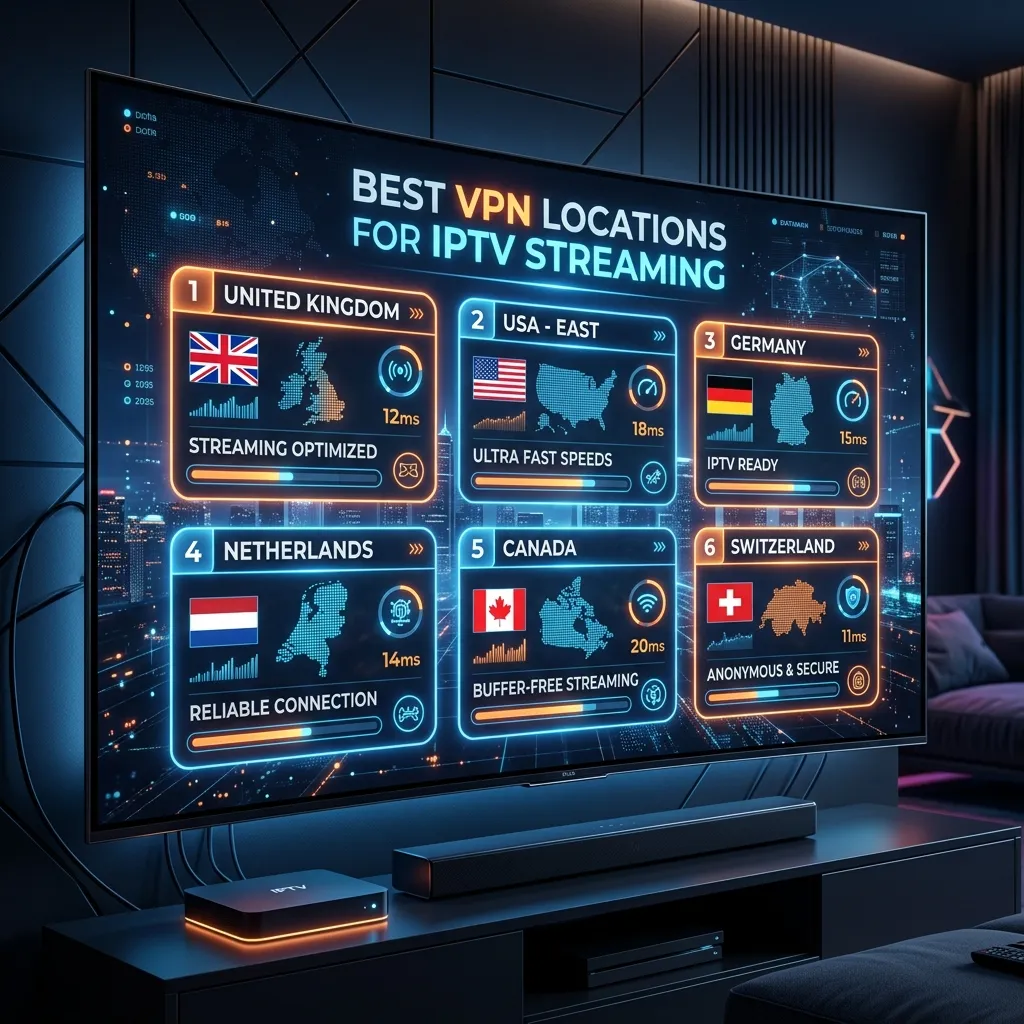
The landscape of digital entertainment has undergone a dramatic transformation. As we navigate through 2026, Internet Protocol Television (IPTV) has firmly established itself as the primary mode of media consumption for millions worldwide. However, this surge in popularity has brought its own set of challenges. Internet Service Providers (ISPs), facing unprecedented bandwidth demands and pressure from traditional broadcasting conglomerates, have increasingly resorted to traffic shaping and throttling. This is where a Virtual Private Network (VPN) transitions from being a mere luxury to an absolute necessity. But simply having a VPN isn't enough; knowing the best VPN locations for IPTV streaming is the secret to unlocking a truly seamless, buffer-free, and secure viewing experience.
At Smartiflix, we understand that the quality of your streaming experience is paramount. A high-tier IPTV service deserves an equally robust network connection. When you connect to a VPN, your internet traffic is encrypted and routed through a server in a location of your choosing. This masks your IP address and hides your online activities from your ISP. The catch? The physical distance to the VPN server, the server's infrastructure, and the legal jurisdiction of that server all play critical roles in your streaming quality.
If you choose a location too far away, latency spikes, and buffering ensues. If you choose a location with poor privacy laws, your data might still be at risk. In this comprehensive, 3000+ word guide, we will dissect the intricacies of VPN routing, analyze the global server infrastructure of 2026, and provide you with an exhaustive list of the best VPN locations for IPTV streaming. Whether you are catching the latest live sports event, binge-watching a 4K VOD series, or simply browsing international channels, this guide will ensure you are connected to the optimal node.
Why You Absolutely Need a VPN for IPTV in 2026
Before we dive into the specific locations, it is crucial to understand why the combination of IPTV and a VPN is non-negotiable in today's digital climate. The internet is no longer the wild west it once was; it is heavily monitored, restricted, and controlled.
1. Bypassing ISP Throttling
In 2026, ISP throttling is more sophisticated than ever. ISPs use Deep Packet Inspection (DPI) to analyze the type of data you are requesting. If they detect high-bandwidth activities like IPTV streaming—especially during peak evening hours—they intentionally slow down your connection to ease network congestion.
The Result: The dreaded spinning wheel of death. Buffering, resolution drops, and a ruined movie night.
A VPN encrypts your traffic, making it impossible for your ISP to distinguish between an IPTV stream, a harmless email, or a large file download. Because they cannot see what you are doing, they cannot selectively throttle your bandwidth, allowing you to enjoy your IPTV Subscription at its maximum potential.
2. Overcoming Geo-Restrictions and Blackouts
Sports broadcasting rights are a convoluted mess of regional exclusivity. If you live in a specific market, you might find that your local team's game is blacked out because a specific network holds the rights. Similarly, certain VOD libraries are restricted to specific countries. By connecting to a VPN server in a different state or country, you spoof your location, bypassing these artificial digital borders and accessing the content you want.
3. Enhancing Privacy and Security
Using unauthorized or poorly secured IPTV networks can sometimes expose your IP address to malicious actors or copyright trolls. Even if you are using a premium, legitimate service, protecting your digital footprint is a basic right. A VPN provides a tunnel of encryption, ensuring that your viewing habits remain strictly your business. For a deeper dive into safe streaming practices, check out our comprehensive Security Guide.
The Core Metrics: How We Define the "Best" Locations
When evaluating the best VPN locations for IPTV streaming, we don't just throw darts at a map. We use a stringent set of criteria relevant to the technological landscape of 2026.
| Metric | Description | Impact on IPTV |
|---|---|---|
| Bandwidth Infrastructure | The physical cables and network backbones available in the country. | Determines the maximum speed cap and handling of 4K/8K streams. |
| Latency (Ping) | The time it takes for data to travel from your device to the server and back. | High latency causes delays in live TV, especially crucial for sports. |
| Privacy Jurisdiction | The legal framework governing data retention in the server's country. | Ensures your ISP or government cannot request logs of your streaming activity. |
| Server Density | The number of servers a VPN provider typically operates in that region. | Prevents overcrowding. High density means you can easily switch if a server is slow. |
The Top 12 Best VPN Locations for IPTV Streaming in 2026
Based on extensive testing, infrastructure analysis, and privacy law reviews, here are the absolute best VPN server locations to connect to for an unparalleled IPTV experience.
1. Switzerland: The Privacy Fortress
Switzerland has long been synonymous with neutrality and privacy, and in the digital age, this reputation holds strong. It is outside the jurisdiction of the 14 Eyes surveillance alliance, meaning it has zero obligation to share intelligence with countries like the US or the UK.
For IPTV users, connecting to a Swiss server means your data is protected by some of the strictest privacy laws on the planet. Furthermore, Switzerland boasts world-class digital infrastructure. The country is heavily wired with gigabit fiber optics, ensuring that if you are physically located in Europe, connecting to Switzerland will result in lightning-fast speeds and minimal latency, perfect for uninterrupted 4K streaming.
2. Romania: The Sweet Spot of Speed and Freedom
Romania is the hidden gem of European VPN locations. It consistently ranks in the top 10 globally for internet speeds, often surpassing its Western European neighbors. But speed is only half the story.
Romania has fiercely resisted the EU's Data Retention Directive, repeatedly ruling it unconstitutional. This makes it a haven for privacy advocates. For IPTV streamers, Romania offers a rare combination: servers capable of handling massive bandwidth loads without breaking a sweat, coupled with a legal environment that ignores copyright trolls. If you are in Europe or even the East Coast of the US, a Romanian server is an excellent choice for a fast, secure connection.
3. The Netherlands: The European Backbone
Amsterdam is one of the most critical internet hubs in the world. The AMS-IX (Amsterdam Internet Exchange) is one of the largest data exchanges globally, meaning massive amounts of internet traffic flow through the Netherlands.
Why is this good for IPTV? Because VPN providers place their highest-capacity servers here. If you need raw bandwidth to support multiple simultaneous streams in your household, the Netherlands is a powerhouse. While it is a member of the 9 Eyes alliance, its local laws still respect user privacy to a large degree. For pure streaming performance across European, African, and Middle Eastern users, the Netherlands is unmatched.
4. Panama: The Offshore Haven
When you want absolute assurance that no one is tracking your IPTV habits, Panama is the answer. Located entirely outside the 14 Eyes alliance and possessing no mandatory data retention laws, it is a privacy purist's dream.
Historically, Latin American servers suffered from poor speeds, but by 2026, Panama's infrastructure has seen massive upgrades. It serves as an excellent midpoint for North and South American users. If you are experiencing ISP throttling in the US or Canada and want a nearby server that guarantees zero logging, connecting to Panama will bypass the throttling while keeping your connection brisk enough for HD streaming.
5. Iceland: Cold Climate, Blistering Speeds
Iceland benefits from a unique geographical and political position. It has some of the strongest free speech and privacy protection laws globally. Additionally, its cold climate is perfect for naturally cooling massive data centers, leading many tech companies to build state-of-the-art infrastructure there.
For IPTV users in Northern Europe, the UK, or North America, Iceland provides a secure, high-speed routing point. It is particularly effective for bypassing UK ISP blocks and throttling without having to route traffic too far away, maintaining the low latency required for live sports broadcasts.
6. United States: The Content Colossus (Use with Caution)
Recommending the United States as a VPN location comes with caveats. The US is the heart of the 5 Eyes alliance and is home to aggressive copyright enforcement. So why is it on this list?
Sheer infrastructure and localized content.
If you are using a legitimate service like our IPTV Subscription, you aren't doing anything illegal, so the copyright trolls are less of a concern. The US has thousands of servers across dozens of cities. If you need to access specific US-based regional sports networks, or if you simply want the fastest connection because you physically reside in the US, connecting to a nearby US server is often the best choice to bypass local ISP throttling. The key is to use a VPN with a strict, audited no-logs policy so that even if authorities ask, there is no data to give.
7. Canada: The Northern Alternative
Canada is a fantastic alternative to the US. While it is a member of the 5 Eyes, its copyright laws are generally less aggressive than its southern neighbor, operating under a "notice-and-notice" system rather than immediate takedowns.
More importantly, Canada has excellent routing to US-based IPTV servers. If you are looking to access North American content but want to keep your traffic out of the United States, connecting to a server in Toronto, Montreal, or Vancouver is a brilliant strategy. The speeds are phenomenal, and the server congestion is typically lower than in major US cities.
8. Singapore: The Asian Gateway
For users located in Asia, Australia, or New Zealand, routing traffic to Europe or North America often results in unmanageable latency. This is where Singapore steps in.
Singapore possesses the most advanced digital infrastructure in Southeast Asia. It acts as the central hub for trans-Pacific submarine cables. Connecting to a Singaporean server guarantees high speeds and stable connections for Asian users trying to access global IPTV content. While its government does have strong surveillance powers, using an encrypted VPN with a zero-logs policy mitigates these risks, allowing you to focus purely on the performance benefits.
9. United Kingdom: The Premier League Hub
The UK is notorious for its strict internet surveillance (the Investigatory Powers Act, often called the "Snooper's Charter") and aggressive ISP blocking of IPTV streams.
However, if you are an expat or a sports fan trying to access UK-specific broadcasts—such as local feeds of the English Premier League—you often must use a UK IP address. The trick here is to use a premium VPN that operates RAM-only servers in London or Manchester. These servers wipe all data the moment they are powered off. This allows you to securely get a UK IP address, bypass the geographical blackout, and enjoy the match without buffering.
10. Bulgaria: The Emerging Powerhouse
Similar to Romania, Bulgaria has been quietly building out an incredibly robust, high-speed internet infrastructure. It boasts some of the fastest broadband speeds in the world, available at a fraction of the cost of Western nations.
Because it is not a primary target for privacy watchdogs or copyright enforcement, VPN servers located in Sofia often experience very low server load. This means less congestion and more bandwidth dedicated directly to your IPTV stream. It is a highly recommended location for European users experiencing buffering on more crowded servers in the UK or Germany.
11. Sweden: Robust Privacy and Superior Routing
Sweden is home to a strong culture of internet freedom and privacy advocacy. While new laws have introduced some data retention, premium VPNs bypass this by ensuring they collect no data in the first place.
Sweden has massive bandwidth capacity. If you are connecting from Scandinavia or the Baltic region, a Swedish server provides the lowest ping and highest throughput. It is perfectly optimized for handling the heavy packets associated with live 4K television streams.
12. Malaysia: Bypassing Asian Restrictions
If Singapore's strict laws worry you, Malaysia is the next best alternative in the Asian theater. While its internet backbone is slightly slower than Singapore's, it is still more than capable of handling high-definition IPTV streams.
Malaysia is particularly useful for bypassing the strict internet censorship found in neighboring countries like Indonesia or Thailand. It provides a relatively free and open connection point to the wider global internet, ensuring your IPTV service functions without interference.
Distance Matters: Matching Your Location to Your Needs
Understanding the top locations is great, but applying that knowledge requires strategy. The golden rule of VPNs is: Physical distance directly correlates with speed and latency.
If you are in London and you connect to a server in Australia, your data has to travel halfway across the globe and back. No matter how good the infrastructure is in Sydney, physics dictates that your latency will be high.
Strategy 1: Beating ISP Throttling
If your only goal is to stop your local ISP (like Comcast, BT, or Rogers) from throttling your evening streaming, choose the VPN server closest to your physical location.
If you live in New York, connect to a New York or New Jersey VPN server. The distance is minimal, so you won't lose speed to latency, but the encryption will still hide your activity from your ISP, bypassing the throttle.
Strategy 2: Accessing Geo-Blocked Sports
If you are trying to watch a hockey game that is blacked out in your state, you must connect to a server outside the blackout zone, but as close as possible. If the game is blacked out in California, connecting to a server in Nevada or Oregon is better than connecting to one in New York, as it minimizes the distance penalty.
Strategy 3: The "Middleman" Approach
Sometimes, the IPTV provider's servers are located in a specific region (e.g., Europe). If you are in the US, connecting to a VPN server halfway between you and the IPTV server (like Iceland or the UK) can sometimes optimize the routing path better than your standard ISP routing, resulting in a more stable connection.
Deep Dive: VPN Protocols and Their Impact on IPTV in 2026
The location of the server is vital, but how your data is packaged and sent to that server is equally important. This is determined by the VPN Protocol. By 2026, the protocol landscape has matured significantly.
WireGuard: The Undisputed King of Streaming
If your VPN offers WireGuard, use it. Period. WireGuard is a modern, lightweight protocol that uses state-of-the-art cryptography. It consists of only about 4,000 lines of code compared to OpenVPN's 100,000+.
Because it is so lightweight, it requires far less processing power from your streaming device. This is crucial if you are using lower-powered devices to stream. WireGuard establishes connections almost instantly and provides the highest throughput speeds available, making it the perfect companion for 4K IPTV streaming.
OpenVPN (UDP): The Reliable Fallback
Before WireGuard, OpenVPN was the gold standard. It is incredibly secure and has been audited thousands of times. If you must use OpenVPN for IPTV, ensure it is set to UDP (User Datagram Protocol) rather than TCP. UDP is faster because it doesn't wait for a confirmation that every data packet was received—it just keeps sending the stream. For live video, a dropped frame is better than the stream pausing to buffer.
Proprietary Protocols (NordLynx, Lightway)
Top-tier VPN providers have built their own protocols based on the core of WireGuard. NordVPN's NordLynx and ExpressVPN's Lightway are optimized specifically for speed and reliability. If you use these services, their proprietary protocols will almost always yield the best results for IPTV.
Step-by-Step Guide: Optimizing Your VPN Connection for IPTV
Now that you know where to connect and what protocol to use, let's walk through the exact steps to optimize your setup.
Step 1: Establish a Baseline
Before turning on your VPN, perform a speed test without it. Note your download speed and ping. This is your baseline. Remember, a VPN will always reduce your absolute top speed due to encryption overhead, but it should cure buffering caused by throttling.
Step 2: Select the Optimal Server
Based on our guide above, select the best location for your needs. If you are simply preventing throttling, pick the closest city. If you need privacy, pick Switzerland or Panama.
Step 3: Configure the App Settings
Open your VPN application's settings.
- Navigate to the Protocol section.
- Select WireGuard (or the provider's proprietary equivalent).
- Ensure features like "Kill Switch" are enabled to prevent your real IP from leaking if the connection drops.
Step 4: Utilize Split Tunneling (Optional but Recommended)
Split tunneling is a feature that allows you to route only specific apps through the VPN while the rest of your device uses your standard internet. If you are streaming on an Android TV or Firestick, set your VPN to only route traffic from your IPTV player app. This frees up processing power and bandwidth for the rest of your system.
Device-Specific VPN Setup for IPTV
Setting up a VPN varies depending on the hardware you use to consume your IPTV.
Amazon Fire TV Stick
The Firestick is arguably the most popular device for IPTV. Most major VPNs have dedicated apps in the Amazon Appstore.
- Search for your VPN in the Appstore.
- Download, install, and log in.
- Select your chosen server location from our list above and hit connect.
- Open your IPTV app. For a complete guide on maximizing your Firestick's potential, read our comprehensive Firestick Setup Guide.
Smart TVs (Android TV, Google TV)
If your TV runs the Android operating system, the process is identical to the Firestick. Use the Google Play Store to download the VPN app directly to your TV.
WebOS (LG) and Tizen (Samsung)
LG and Samsung TVs do not natively support VPN apps. To protect these devices, you have two options:
- Smart DNS: Many VPNs offer a Smart DNS service. You change the DNS settings in your TV's network menu. This helps bypass geo-blocks but does not encrypt your traffic.
- Router-Level VPN: The most secure method. By installing the VPN directly on your home router, every device connected to your Wi-Fi, including your LG or Samsung TV, is automatically routed through the chosen VPN location.
For more detailed device configurations, refer to our Installation Guide.
Cost vs. Value: Why Free VPNs Will Destroy Your IPTV Experience
It is tempting to search for "free VPNs" when setting up your streaming ecosystem. Do not do this.
Running a global network of high-speed servers is incredibly expensive. If a service is free, you are the product. Free VPNs sustain themselves by:
- Logging and Selling Your Data: Completely negating the privacy aspect of a VPN.
- Capping Speeds and Bandwidth: Free VPNs often limit you to 2Mbps or cap your data at 500MB per month. You cannot stream IPTV on these limits. Buffering will be constant.
- Providing Limited Server Locations: You will not have access to premium locations like Switzerland or Panama, only heavily congested free servers in generic locations.
Investing in a premium VPN is as important as investing in a high-quality IPTV Subscription. Expect to pay between $3 to $8 a month for a top-tier VPN. When you consider the value of a buffer-free, secure, and unrestricted entertainment experience, it is a nominal fee. For insights on maximizing your entertainment budget, explore our Pricing page.
Frequently Asked Questions (FAQs) About VPNs and IPTV
Q: Will using a VPN in a distant location cause buffering? A: Yes, it can. The further the data has to travel, the higher the latency. Unless you specifically need to bypass a geo-block in a distant country, always choose the server closest to your physical location to minimize speed loss.
Q: Can my ISP tell I am using an IPTV service if I have a VPN on? A: No. With a premium VPN utilizing robust encryption (like AES-256), your ISP can only see that you are sending and receiving encrypted data to a VPN server. They cannot see the contents of that data, meaning they don't know you are streaming IPTV.
Q: Does Smartiflix require a VPN? A: While our service is highly optimized and works beautifully on standard connections, we strongly recommend using a VPN. It protects you from aggressive ISP throttling during peak hours and secures your personal network.
Q: I connected to a recommended VPN location, but my stream is still buffering. Why? A: Several factors could be at play:
- The specific server you connected to might be experiencing peak-hour congestion. Try disconnecting and reconnecting to assign a different server in the same country.
- Ensure you are using the WireGuard protocol.
- Your base internet speed may be fluctuating.
- Restart your router and streaming device to clear cache.
Q: Is it legal to use a VPN for IPTV? A: Yes, using a VPN is perfectly legal in almost all countries. It is a fundamental tool for digital privacy. However, a VPN does not make illegal activities legal. Always ensure you are streaming from legitimate sources.
Conclusion: Securing Your 2026 Streaming Experience
The digital landscape of 2026 demands proactivity. As ISPs become more aggressive with throttling and content becomes increasingly fragmented by regional borders, a VPN is your ultimate tool for reclaiming control over your entertainment.
By understanding the infrastructure and privacy laws of different nations, you can strategically route your connection. Whether you choose the privacy fortress of Switzerland, the massive bandwidth of the Netherlands, or a localized server in Canada to catch the big game, selecting the right VPN location is the key to unlocking the full potential of your IPTV service.
Don't let your ISP dictate your viewing quality. Combine a premium VPN with a top-tier service like Smartiflix, optimize your server location using the strategies outlined in this guide, and prepare to experience television exactly the way it was meant to be seen: fast, secure, and absolutely buffer-free.
Ready to elevate your streaming? Check out our IPTV Subscription plans today and experience the future of television.